
Types of Rice Milling Machines: Complete Buyer Guide
Quick answer: The main types of rice milling machines are paddy cleaners, destoners, hullers or shellers, paddy separators, rice whiteners, polishers, graders, color sorters, conveyors and packing machines. A complete mill combines these machines in the correct order and capacity. Buyers should select the process from paddy condition, finished-rice quality, throughput, packing method and local service requirements rather than choosing isolated machines from catalogue names.
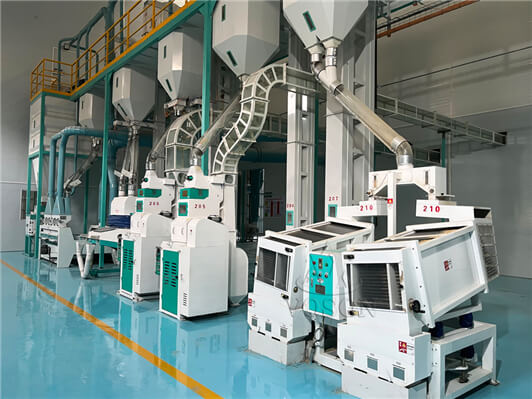
Rice milling machines by process stage
| Process stage | Typical machines | Main buyer decision |
|---|---|---|
| Paddy preparation | Pre-cleaner, vibrating screen, magnet and destoner | Impurity level, receiving method and stone-removal requirement |
| Husking | Rubber-roll huller, husk aspirator and paddy separator | Paddy variety, moisture, hulling rate and return flow |
| Whitening | Emery or iron-roll whitener and bran aspiration | Whiteness, milling recovery, temperature and number of passes |
| Finishing | Rice polisher, thickness grader and length grader | Surface finish, broken-rice grades and target market |
| Sorting | Color sorter and inspection equipment | Defect standard, throughput and compressed-air quality |
| Packing | Bins, weighing scale, bagging and sewing machine | Bag sizes, accuracy, speed and automation level |
Paddy cleaning and destoning machines
Cleaning protects every downstream machine. A pre-cleaner removes straw, dust and large impurities, while a vibrating screen separates material by size. Magnets protect equipment from metal, and a destoner removes stones and other heavy impurities by density. The selected capacity should handle receiving peaks without starving the mill during normal production.
Ask the supplier to state the expected impurity level, screen arrangement, aspiration requirement and cleaning efficiency assumptions. Review the rice mill vibrating screen when comparing screen area, deck arrangement, motors and maintenance access.
Paddy huller or sheller
A rubber-roll huller removes the husk from cleaned paddy. Two rubber rollers rotate at different surface speeds and pull the grain through a controlled gap. Feed distribution, roller pressure, paddy moisture and roller condition affect hulling rate, broken rice and rubber consumption.
The sheller normally works with husk aspiration. Air removes loose husk before the grain reaches the separator. The quotation should show whether the fan, ducts, cyclone or dust connection and controls are included. Compare the rubber roller huller with the cleaner output and the separator return-flow requirement.
Paddy separator
After husking, the product stream contains brown rice and unhusked paddy. A paddy separator divides these materials so brown rice moves forward and unhusked grains return to the huller. Separation efficiency affects line capacity, grain quality and the amount of repeated processing.
Selection depends on huller capacity, paddy variety, moisture, deck area and adjustment range. A separator that is too small creates a bottleneck even when the huller has sufficient nominal capacity. See the paddy separator guide for buyer checks and trial measurements.
Rice whitener and milling chamber types
Whiteners remove bran from brown rice. Emery or abrasive systems and friction-based iron-roll systems apply different milling actions, and many commercial plants use more than one stage. Splitting the work across controlled passes can improve temperature control, surface consistency and head-rice yield.
The supplier should know the incoming brown-rice condition, required whiteness, milling recovery, broken-rice limit and downstream finishing process. Ask how pressure, feed rate, airflow and outlet resistance are adjusted, and which screens or milling parts should be stocked.
Rice polishing machines
Polishing follows whitening and improves surface cleanliness and appearance. Controlled grain contact, airflow and, in mist-polishing designs, a measured water addition remove loose bran powder and smooth the rice surface. Excessive chamber pressure or unsuitable moisture can increase temperature and broken rice.
A polisher cannot correct poor upstream whitening. It should match the whitener output and the downstream grader or sorter. The rice polishing machine guide explains settings, trial measurements and spare-parts planning.
Rice grading and sorting machines
Graders separate rice by thickness, length or broken-rice size. The correct combination depends on how many saleable grades the buyer wants to produce. A thickness grader can remove immature or thin grains, while length grading separates head rice from different broken fractions.
Color sorting is used when the market requires removal of discolored grains or other visible defects. Sorter capacity, number of chutes, camera system, ejector demand and compressed-air quality should be matched to the incoming defect level. Buyers can review the rice grading machine when planning the finishing section.
Weighing and packing machines
The packing section must handle the required bag sizes and total production without becoming the final bottleneck. Systems can range from simple weighing and sewing to automated bag feeding, filling, sealing, coding and pallet handling. Packing accuracy, speed, product flow and dust control should be tested with the intended bags.
Confirm whether bins, conveyors, compressor, printer, sewing head, spare parts and controls are included. Compare available rice packing machine options with the number of finished grades and warehouse arrangement.
Complete line configurations for different buyers
| Line type | Typical process scope | Best suited to |
|---|---|---|
| Compact basic line | Cleaning, husking, separation, whitening and simple grading | Local bulk markets and straightforward operation |
| Commercial line | Basic line plus polishing, improved grading, bins and controlled conveying | Consistent finished appearance and several rice grades |
| Retail-ready line | Commercial line plus color sorting and automatic weighing and packing | Branded retail or export-quality products |
| Flexible multi-product line | Additional bins, bypasses, sort settings and multiple packing formats | Plants processing several varieties and market specifications |
How to choose the right machine combination
Start with paddy data and the finished product, not with the machine list. Provide paddy variety, moisture, impurity level, required input or output capacity, operating hours, finished-rice quality, by-products, bag sizes, voltage and site dimensions. The supplier should explain why each stage and model is included.
Capacity must be balanced from intake to packing. A high-capacity whitener does not solve an undersized cleaner, separator, grader or packer. Ask for a process flow, equipment schedule, motor list, layout and utility table. Use the rice mill machine category for individual equipment and the rice mill plant category for complete configurations.
Supplier quotation and acceptance checklist
Compare quotations against the same process and capacity basis. Check model numbers, motors, conveyors, bins, platforms, aspiration, dust collection, controls, spare parts, delivery term, installation boundary, drawings and warranty. Mark every exclusion so a low subtotal is not mistaken for a complete line.
Agree on trial material and acceptance values before shipment or commissioning. Useful records include paddy input, finished output, throughput, milling recovery, broken rice, visible defects, motor loads and downtime. Keep samples and settings with the signed result.
How VOSON develops a machine list
Our review starts with the raw paddy, finished-product target and production schedule. We define each process stage, balance its capacity with adjacent machines, identify utilities and building limits, and separate essential equipment from options. The resulting list is intended to make the quotation, layout and test standard describe the same plant.
Use the Rice Mill Project Planning Hub for the full project workflow, or send paddy data, capacity, quality target, voltage, destination and site limits through Contact. For independent background on milling stages, consult the International Rice Research Institute Rice Knowledge Bank.
Types of rice milling machines FAQ
Which machine should be selected first?
Define the paddy, required capacity and finished-rice standard first. Then design the process flow and select balanced machines for each stage.
Is a rice huller the same as a complete rice mill?
No. A huller removes husk. A complete mill can also clean, separate, whiten, polish, grade, sort and pack rice.
When is a rice polisher needed?
Polishing is useful when the target market values a cleaner, smoother rice surface after whitening.
When should a buyer add a color sorter?
Add color sorting when the finished product has a defined limit for discolored grains or visible defects that mechanical grading cannot remove.
Can some machines be removed to reduce price?
Yes, when the omitted stage is not required for the raw material or target market. Removing essential cleaning, separation or dust-control functions can reduce yield and stability.
What information is required for machine selection?
Provide paddy condition, input or output capacity, operating hours, quality target, packing, voltage, site dimensions, destination and service expectations.