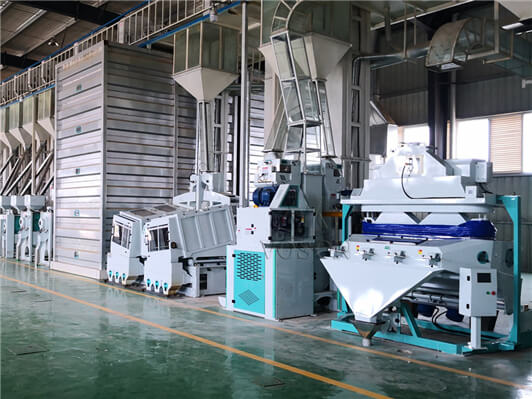
100 ton rice mill project cost starts with the capacity basis
A 100 TPD plant running two shifts is not comparable with a 100 TPH industrial complex. State operating hours, planned downtime and the material measured at the capacity point. Then calculate the required hourly flow through intake, cleaning, husking, whitening, grading, sorting and packing.
The IRRI commercial milling reference describes the multi-stage commercial process. It is a useful process framework, but actual machine quantities and project costs must be based on the buyer's paddy, product specification and site.
| Budget section |
Scope to define |
Evidence to request |
| Process machinery |
Cleaning, husking, separation, whitening, polishing, grading, sorting and packing. |
Process flow, model schedule, capacity calculation, motor list and acceptance values. |
| Storage and drying |
Seasonal intake, paddy moisture, storage days, dryer fuel and finished-product bins. |
Mass balance, silo schedule, dryer basis and material-handling rates. |
| Building and civil work |
Foundations, floors, platforms, warehouse, roads, drainage and maintenance access. |
Dimensioned layout, equipment loads, openings and local civil estimate. |
| Power and utilities |
Transformer, distribution, compressed air, water, aspiration, dust collection and backup power. |
Connected load, peak demand, utility schedule and responsibility boundary. |
| Delivery and startup |
Freight, unloading, erection, wiring, commissioning, training, spares and trial material. |
Responsibility matrix, schedule, warranty and performance-test protocol. |
Separate machinery price, installed cost and startup budget
Machinery supply
The equipment price may cover only the named machines, motors and control panels. Ask whether elevators, conveyors, bins, platforms, aspiration ducts, dust collectors, laboratory equipment, packing conveyors and commissioning spares are included. The model and quantity schedule should match the process drawing.
Installed project cost
An installed budget adds freight, import handling, foundations, buildings, transformer and cables, compressed air, water, structural steel, erection and local labor. Suppliers and buyers should sign a responsibility matrix so that every interface has one owner.
Startup and operating provision
Trial paddy, operator training, initial spare parts, packaging materials, quality testing and working capital are not the same as equipment cost. For operating comparisons, record expected labor, connected load, consumables, wear parts and planned maintenance without presenting them as guaranteed values before a site-specific study.
Inputs that materially change the project budget
Paddy moisture and impurity affect intake cleaning, drying and storage. Finished-rice grades affect the number of whitening, polishing, grading and sorting stages. Retail bag sizes can change the packing section and warehouse flow. Site voltage, climate, building limits and local construction practice affect utilities and civil work.
Send representative paddy samples where possible. Define acceptable recovery, head-rice fraction, broken-rice grades, milling degree, visible defects and bag formats. These inputs allow a supplier to design for a measurable result instead of selecting equipment from a generic capacity label.
Storage, drying and logistics can change the plant scale
A milling line sized for 100 TPD does not automatically provide enough receiving, drying or storage capacity for seasonal procurement. Calculate peak truck intake, wet-paddy handling, dryer cycles, raw-material storage days, finished-product storage and by-product dispatch separately.
Review the available grain silos and grain dryers only after those operating assumptions are documented. Their quantity and transfer rate should appear in the mass-flow diagram and site layout.
How to compare 100 ton rice mill quotations
Give every supplier the same input sheet. It should state paddy variety and moisture, required products and grades, bag formats, voltage, site dimensions, operating schedule and destination. Ask each bidder to identify included equipment, local work, exclusions and assumptions instead of comparing only the final price.
| Quotation check |
Question to answer |
Risk if missing |
| Capacity |
Is the guarantee based on paddy input, finished output, TPD or TPH? |
Offers describe different plant sizes. |
| Product quality |
Which recovery, head-rice, broken-rice and defect limits apply? |
Throughput is quoted without a comparable product result. |
| Line balance |
Are elevators, bins, sorters and packers sized for the same flow? |
A secondary section restricts the whole plant. |
| Site scope |
Who supplies civil work, cables, ducts, platforms and local labor? |
Major installed-cost items appear after purchase. |
| Acceptance |
What paddy, runtime, measurements and downtime rules will be used? |
Performance claims cannot be verified consistently. |
Use a measurable acceptance protocol
The acceptance test should identify the trial paddy, test duration, stable-production period, permitted downtime and measurement instruments. Record paddy input, finished-rice output, recovery, grade fractions, product quality, power demand and packing performance. A supplier claim without a shared test method is not a reliable basis for comparing project cost.
Project documents needed before a firm quotation
Request a process flow, equipment and motor schedule, layout, utility schedule, civil-load information, commercial responsibility matrix, spare-parts list and acceptance protocol. For a configured line, review the 100 ton rice mill production line and the wider rice mill plant range.
Use the Rice Mill Project Planning Hub and rice mill cost estimation guide, then send the capacity basis, paddy data, product specification, site country and drawings through Contact.
100 ton rice mill project cost FAQ
Is 100 TPD the same as 100 TPH?
No. TPD is daily throughput and TPH is hourly throughput. Their machinery, storage, building, power and logistics requirements differ greatly.
Does a machine quotation include the complete factory?
Not automatically. Civil work, utilities, freight, local installation, trial production and working capital may be outside the quoted machinery scope.
Why is there no universal 100 ton project price?
The cost changes with the capacity definition, paddy condition, product grades, storage, drying, automation, site infrastructure and delivery boundary.
What should buyers send for a budget proposal?
Send paddy data, input or output basis, shifts, finished-rice targets, bag formats, voltage, destination, site dimensions and required supplier services.
How should competing quotations be compared?
Use one common input sheet and compare process flow, machine quantities, utilities, civil boundaries, exclusions, spares and acceptance values.
What should a performance test record?
Record input rate, finished output, recovery, grade fractions, product quality, power demand, packing speed, downtime and trial-paddy condition.