
1 Ton Rice Mill Project Cost 2026: Small Plant Budget Checklist
A 1 ton rice mill project cost is usually planned for a small commercial mill, village processing plant, farm-side mill, pilot production line or local rice trading business. The budget is smaller than a multi-ton industrial plant, but it still needs a clear project boundary. Buyers should not compare only the main machine price, because cleaning, husking, polishing, power, building work, installation and spare parts can change the final investment.
This guide is written for buyers who want a supplier-ready quotation. It explains the main cost sections, the information a buyer should prepare, and the common items that make a small rice mill estimate look cheaper or more expensive than another offer.
Define what 1 ton means before estimating cost
The first step is to confirm whether 1 ton means paddy input per hour, finished rice output per hour, or daily finished rice production. These are different project sizes. Paddy moisture, impurity level, expected recovery, broken-rice tolerance and working hours all affect the equipment selection.
For a small plant, this capacity definition matters even more. A buyer may only need a compact semi-automatic line, while another buyer may need stronger cleaning, polishing, grading, packing and storage because the finished rice will be sold as a branded product.
| Capacity basis | What it means | Why it changes the budget |
|---|---|---|
| 1 TPH paddy input | The line receives about 1 ton of paddy per hour. | Finished rice output depends on milling recovery and paddy quality. |
| 1 TPH finished rice output | The line produces about 1 ton of finished rice per hour. | Machines and elevators may need to be larger than a 1 TPH paddy-input line. |
| 1 ton per day | The business target is about 1 ton of finished rice per day. | A smaller machine set and simpler layout may be enough. |
| Seasonal small mill | The plant runs heavily during harvest season. | Spare parts, drying, storage and maintenance planning become more important. |
Main machinery in a 1 ton rice mill project
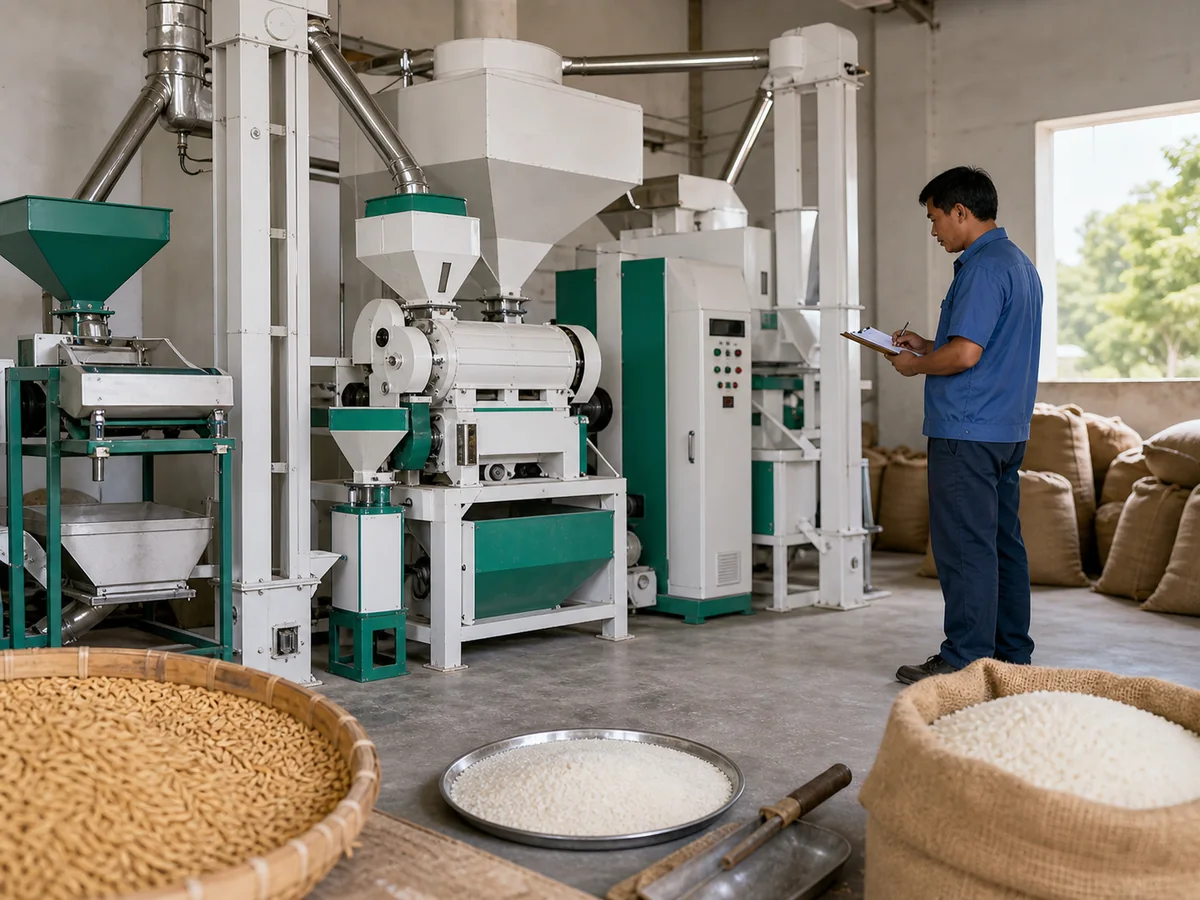
A practical 1 ton line may include paddy cleaner, destoner, rubber roller husker, paddy separator, rice whitener, rice polisher, grader, elevators and a simple packing machine. Depending on the target market, the buyer may add color sorting, automatic weighing, bins or dust collection.
For machine-level comparison, review Rice Mill Machine. For complete line planning, review Rice Mill Plant. If the buyer wants to estimate every project section first, use the rice mill cost estimation 2026 guide.
1 ton rice mill project cost checklist
| Cost section | What to include | Buyer evidence to prepare |
|---|---|---|
| Core machines | Cleaner, destoner, husker, separator, whitener, polisher, grader and packing. | Paddy condition, finished rice quality target and capacity basis. |
| Auxiliary equipment | Elevators, conveyors, bins, motors, dust pipes and electrical cabinet. | Workshop size, floor height, power supply and automation preference. |
| Site preparation | Floor, foundation, small platform, drainage, ventilation and maintenance access. | Workshop drawing, local construction cost and available floor area. |
| Power and utilities | Voltage, transformer capacity, wiring, compressed air if needed and lighting. | Local voltage, installed power limit and electrician estimate. |
| Delivery and installation | Freight, unloading, local transport, installation guidance, test paddy and training. | Destination country, site readiness date and local labor plan. |
| Startup operation | Spare parts, wear parts, packaging bags, maintenance tools and working capital. | Harvest season, sales plan, packaging method and first-year spare-parts list. |
What can make a small rice mill quote look cheaper
A low quote may exclude elevators, motors, electrical cabinet, packing machine, spare parts, installation guidance, color sorter, dust control or freight. It may also use a different capacity basis. That is why buyers should ask suppliers to list included and excluded items clearly.
Small projects are often budget-sensitive, but removing the wrong item can create downtime later. For example, weak cleaning or poor paddy separation can reduce rice quality, while missing spare parts can stop production during peak harvest season.
When dryer and storage should be included
Not every 1 ton project needs a dryer or silo. If the plant mills dry paddy from a stable supplier, a simple warehouse may be enough. But if the buyer receives wet paddy, buys during harvest season, or wants to store paddy before milling, drying and storage should be included in the budget discussion.
For that part of the project, compare Grain Dryer and Grain Silos options. These systems may increase the initial investment, but they can protect rice quality and reduce seasonal risk.
How to compare 1 ton with larger rice mill projects
A 1 ton rice mill is usually easier to install and operate than a larger plant, but the cost per ton of capacity may be higher because some basic systems are still needed. Buyers planning future expansion should compare layout space, power reserve, elevator capacity and building height before placing the order.
For capacity comparison, read the 4 ton rice mill project cost guide, the 5 ton rice mill project cost guide and the 100 ton rice mill project cost guide.
Information to send for a reliable quotation
Send the supplier your paddy variety, moisture, impurity level, expected output, capacity basis, working hours, target rice quality, packing method, voltage, workshop size and destination country. If the factory building already exists, share photos, floor dimensions and power details.
For a wider setup view, compare the rice mill project cost guide and the rice mill factory setup cost guide. For a supplier review, send your project boundary through Contact.
Reference for post-harvest process planning
For general rice post-harvest process background, buyers can review the FAO post-harvest operations reference. Use it for process context, then confirm the actual machine configuration, installation boundary and site requirements with the equipment supplier.
1 ton rice mill project cost FAQ
Is a 1 ton rice mill suitable for a small business?
Yes. A 1 ton rice mill can suit small commercial milling, farm-side processing or local trading, as long as the buyer confirms paddy supply, target rice quality and operating hours.
What is included in a 1 ton rice mill project cost?
It should include core machines, elevators, electrical system, workshop preparation, delivery, installation guidance, spare parts, training and startup working capital.
Does 1 ton mean paddy input or finished rice output?
It depends on the quotation. Buyers should ask suppliers to state the capacity basis clearly before comparing prices.
Can a 1 ton rice mill be expanded later?
Expansion is possible if the workshop, power supply, layout and some auxiliary systems are planned with future capacity in mind.
Does a small rice mill need a dryer?
A dryer is useful when paddy moisture is high, harvest intake is seasonal or the buyer needs stable moisture before milling and storage.
What should buyers send before asking for a quote?
Send paddy condition, capacity basis, working hours, rice quality target, packing method, site country, voltage, workshop size and installation expectations.
A good 1 ton rice mill project cost is not just a machine price. It is a practical budget for a small production system that can receive paddy, mill consistently, pack finished rice and keep running during the buyer's busiest season.